Tuesday, 12 August 2014

Some Celebrations at the Mill

Our Tudor Festival this year was as much fun as ever.  Tunes from the era were performed throughout the day adding period feel as the music drifted across the site.  We're lucky to have amongst our millers the very talented Chris Hocking, part of the duo, (occasionally trio), FayrePlay who perform music from medieval to Victorian and incidentally have a great new CD out (gratuitous plug from a supportive colleague!). 
 
We enjoyed stories from Tudor times from Tom,
 
We got visitors trying dances from Arbeau's 'Orchesographie' of 1589,
 
And we turned a lot of wheat into flour too!
 
Our next events are Heritage Open Days on Saturday 13th and Sunday 14th September, when we will be free for the weekend in support of this national event celebrating historic and architectural treasures.
 
Then on Saturday 27th and Sunday 28th September we have our ever-popular Victorian Harvest event with butter making, apple pressing, cake tasting (!) and corn grinding as well as music, games and demonstrations of Victorian cycles!
 
Do come along and help us to celebrate!

Wednesday, 11 September 2013

Get exploring some building treasures...

As we've done for several years now, we'll be getting the mill ready to support Heritage Open Days which takes place this weekend.  This is a national celebration of historic buildings and architectural treasures, many of which aren't often open to the public and doors will be open free of charge to encourage people to explore the treasures on their doorstep.

So Stretton Watermill will be giving guided tours of the working watermill with admission being completely free this coming weekend Saturday 14th and Sunday 15th September, doors open from 1-5pm.  If you know someone who has never been, do give them the encouragement to come along.

And if you're heading out to the mill there are some lovely historic churches very near to us which are taking part in Heritage Open Days and are well worth visiting, including the charming St Edith's at Shocklach, with it's Romanesque doorway, Viking carved stone and sheela-na-gig, St Oswald's at Malpas with its medieval gargoyles and ancient oak chest, and St Chad's at Farndon, with its Restoration period stained glass window depicting the Royalist characters, weapons and equipment of the Civil War.

So, lots to see.  You can find a pdf of the brochure for the Chester area by this link.

Sunday, 23 June 2013

Oyez! Come ye to Stretton Fair!

The annual Tudor Festival is coming up soon at Stretton Watermill.  This is where we take the mill back to 1596 when the lease of the mill was taken over by Ursula Leche of nearby Carden Hall.  At that time the mill would have been a thriving business and we try to recreate some of that atmosphere.

There will be Tudor tunes played on period instruments, a storyteller sharing curious happenings and folk tales of millers, a herbalist preparing country cures, along with demonstrations of the ancient machinery as Elizabethan millers grind wheat into flour.

The sergeant of the local militia will also be on the look out for troublemakers, with offenders being placed in the stocks.

Here's the list of offences as fixed to the mill...

The event takes place on Saturday 6th and Sunday 7th July, from 12 noon to 5pm each day.  There will be plenty to keep you fascinated.  And best of all, the event is completely free!   Hope to see you there...

The Witches' Piper

Our mill is full of stories and quite often we have storytelling at our events, there will be some at our Tudor Festival coming soon.  This folk tale isn't really about mills at all, but after discovering this Bulgarian story and telling it in the original form a few times I decided to change it a bit and create a version set in my native Cheshire.  Visitors to Stretton will recognise quite a few names and places in the locality...


You’ve hear how my elder brother plays the bagpipes?  Well, he was called to play for a party at Carden Hall, it must’ve been the day before Ash Wednesday.  And another feller from aback o’ Malpas was called to play his pipes for the children, Uncle Diccen his name is, he still lives in that village.

Now, at around eleven o’clock, Uncle Diccen was paid for his troubles and set off home.  But he was only betwixt Barton and Stretton when he was met by three women, all dressed in grey they were, and they said “Uncle Diccen, Uncle Diccen, come to play for us!” and dragged him away to a house at the end of the lane and set him on a bench there to play.  Well, other folk kept coming in and soon enough the place was thrunk and coins came crashing at Uncle Diccen’s feet until he thought it was as if he had the rent of the Dee Mills, until it turned midnight. 

Then, with a crash, Uncle Diccen found himself at the top of the poplar by Tilston stocks, and the night as black as a bag.  “Odd rot it! How did I get here?” thought Uncle Diccen.  On the lane below there was a chap coming from Shocklach way, and Uncle Diccen called to him to fetch him down, but this feller took boggart at some devil atop a tree at midnight and rushed off.  Soon enough though, there was a horse and cart coming from the Leche’s place and in it was Thomas Hulme.  “Is that you Uncle Diccen?” says Thomas.  “Damn it, of course it’s me! Now help me down.”

As soon as he was on the ground, Uncle Diccen began to look in the hem of his cloak where he’d hidden the coins he’d gathered, but it was full of nothing but broken crockery and chips of glass.  Such strange things sometimes still happen.

Thursday, 25 April 2013

The Cow Is A Mamal

We were just doing the last bits of preparation for our 'Wartime Mill' event this coming weekend - Saturday 27th and Sunday 28th April, 12 noon to 5pm as you're asking - and were looking for something to set our (wooden) cow in context when we came across the following piece in a book about life on the Home Front.  It is so wonderful it just had to be shared...

Many evacuees were seeing the country for the first time.  The nine o'clock news on 29th October 1939 ended with an essay by a ten-year-old East London evacuee:

"The cow is a mamal.  It has six sides, right, left, an upper and below.  At the back it has a tail, on which hangs a brush.  With this it sends the flies away so they do not fall into the milk.  The head is for the purpose of growing horns and so that the mouth can be somewhere.  The horns are to butt with, and the mouth is to moo with.

Under the cow hangs the milk.  It is arranged for milking.  When people milk, the milk comes and there is never an end to the supply.  How the cow does it, I have not yet realized but it makes more and more.

The cow has a fine sense of smell, one can smell it far away.  This is the reason for the fresh air in the country.

The man cow is called an ox.  It is not a mamal.  The cow does not eat much but what it eats it eats twice so that it gets enough.  When it is hungry it moos and when it says nothing it is because all its inside is full up with grass."

So, if you're nearby, do come along and have a try at milking Blossom, our wooden cow, (in the background of the picture above), or Dig for Victory, work a stirrup pump or the air raid siren, practice a gas mask drill, taste some ration book recipes, be recruited to the Home Guard, handle wartime artefacts, take a tour and see wheat being ground into flour and discover how our little rural mill played an important part in the war effort.

Tuesday, 26 March 2013

Mistletoe at the Mill

Regular readers of this blog will know how important our apple trees are to the history and folklore of the mill.  Last autumn we spotted the plentiful balls of mistletoe in the orchard at Norton Priory and wondered whether we could try to get some growing on our trees.  Apple is the preferred host tree for mistletoe, so when the Paul Quigley from NP offered us the chance to plant some mistletoe of their mistletoe upon our trees we seized this gladly. 

Stretton Watermill is located at the northern end of the Marches betwixt England and Wales, whereas the wonderful land of mistletoe is in the southern Marches.  One of the issues in getting mistletoe to establish itself is to obtain the berries from a local plant, mistletoe from Gloucestershire would be unlikely to take well in Cheshire.  Norton Priory had taken berries from a walled garden on the Wirral and now established it in their own walled garden orchard near Runcorn, so these was some of the nearest established plants we could get berries from.

Paul turned up with a plenty of berries, and the clever tips on how to plant them, ignoring the RHS instructions of nicking the bark and trying to wedge the berry underneath. Instead we were to mimic nature and the actions of a mistle thrush rubbing its beak against the tree to remove the sticky inside of the berry, and also to carry out the job in early March, when the berries are ripe, rather than at the end of the Christmas festivities.

The berries are squeezed to get the sticky centre and seeds out.  We gathered these along the edge of our hands, then placed several on a branch, hopefully getting a mix of male and female plants.  We were advised to avoid the older branches with thicker bark.


Paul was happily in tune with our feelings at the mill, that anything we introduce should be done not for purely for beauty, but that it should become a part of the stories of the site, fitting in with its history and legend.  As we worked, we shared tales and folklore of the mistletoe and the trees around our the mill.  If you would like to find out more then travel no further than this excellent mistletoe website.

Mistletoe is slow to establish, in a year we will know whether it has taken at all, but in three or four years we will hopefully see the plant itself on the trees.  Patience is required for this magical plant.

Sunday, 10 February 2013

National Mills Weekend

Each May there is a celebration of mills across the country.  This year we've got some special happenings for mill enthusiasts on Sunday 12th and Monday 13th May.  There'll be stone dressing demonstrations, slide shows on mill heritage presented by millwright Malcolm Cooper, and specialist tours.

The intention is to tailor it to the interests of those attending to make it a very special event.  If you'd like more information or would like to book a place, contact Kate Harland at Cheshire West Museums, 01244 972066 or email kate.harland@cheshirewestandchester.gov.uk

Monday, 21 January 2013

What we did in our Winter Holidays

At the end of the autumn, the mill was awarded Quality Assured Visitor Attraction status by Visit England for the seventh year in a run.  It's lovely to know that in these modern days with gadgets everywhere that the personal touch of millers at an ancient rural watermill is still valued.  We had our last visitors to the watermill in October, some school groups who had come to take part in our wartime mill workshop.  Since then millers have given the place a good clean throughout and put the mill to bed for the winter.  Maintenance work and repairs have taken place on the some of the machinery and the penstock by the overshot wheel.  These are the types of jobs that you can only get done when the mill is closed.  The sluice gates on the by-wash have been open through the winter to send the water past the mill rather than risk damaging the machinery inside if we have heavy rain.  Even so, with the year-long rain that we had in 2012 the pond has remained fairly full this past few months and millers have had to make regular checks on the place. 

As readers of this blog will know there are strong links between apple trees and watermills and so on 12th January, we wassailed our apple trees at the mill in keeping with tradition. 

Friends and people who have been keen supporters of the mill gathered as darkness began to fall.  One of the millers had been busy all day baking cheese scones and mulling cider for everyone to enjoy along with some hot spiced apple juice. 

We listened to the folk tale of the Apple Tree Man, then picked up our drums and bells to process around the trees and make much noise to drive away the evil spirits.

We hung toast in the branches for the birds.  Whatever the apple harvest this year, there was a fine crop of toast.

We sang to the oldest apple tree and poured cider on its roots. 
Then it was done and all headed off to the nearby Carden Arms for a meal and lots of music.


We'll be looking forward to the watermill opening up to everyone again in a few months, beginning with weekend afternoons from April, then each afternoon except Monday from May.  And of course there will be many special events through the spring and summer to bring to life the many stories of our wonderful mill.  Of which, more soon...

Sunday, 30 September 2012

The End of Another Season

At the end of an enjoyable, but tiring, weekend we've now closed to general visitors for the rest of the year, but we've got schools visiting us for the next couple of weeks before the end of season clean and putting the mill to bed. 

As has become tradition now we end our summer with a Victorian Harvest weekend, which suits the time of year and the mill's heritage perfectly.  Of course we've been grinding wheat into flour, but also pressing apples for juice and churning cream into butter.  And where else do you get free cake?!  Our visitors have also enjoyed tastes of apple cake, caraway cake, fruit cake and Victoria sponge all made following old recipes.

There were 19th century tunes from Chris, Joan and Tom.

And Chris once again demonstrated his penny farthing riding skills.


So it was a lovely way to round off a wonderful summer for the mill.  But whilst it gets a bit too cold to have everyone visiting over the winter, the work behind the scenes continues, so expect more from us on this blog over the next few months.

Friday, 10 August 2012

Fancy a Date..?

Being such an ancient mill, you'd expect to find the odd datestone around the place, but when you start looking they're everywhere at Stretton.  Here's a few to look out for...

Some of the former millers are commemorated on plaques, some original, but most painted in more recent times by the renowned folk artist Tony Lewery. 
The old shippen adjacent to the mill building, which today houses the shop and small exhibition, will be two centuries old next year.  We only know this because of the date stone above the door.

The date by the overshot wheel does confuse some people, but the 1977 refers to the restoration and opening as a museum, rather than the installation of a wheel in that location which was done 207 years earlier.
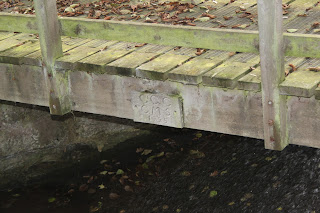
Harder to spot and showing a decline in care in marking a date is the wooden plaque on the access bridge at the rear of the mill installed two decades ago.


This is more like it, from the eighteenth century when people took time over their graffiti.  The I is in fact a J and the M we expect to mean Miller, so it would be John Hughes, Miller.  This carving is on the mill's chimney outside and on another face of the chimney is the longhand version.

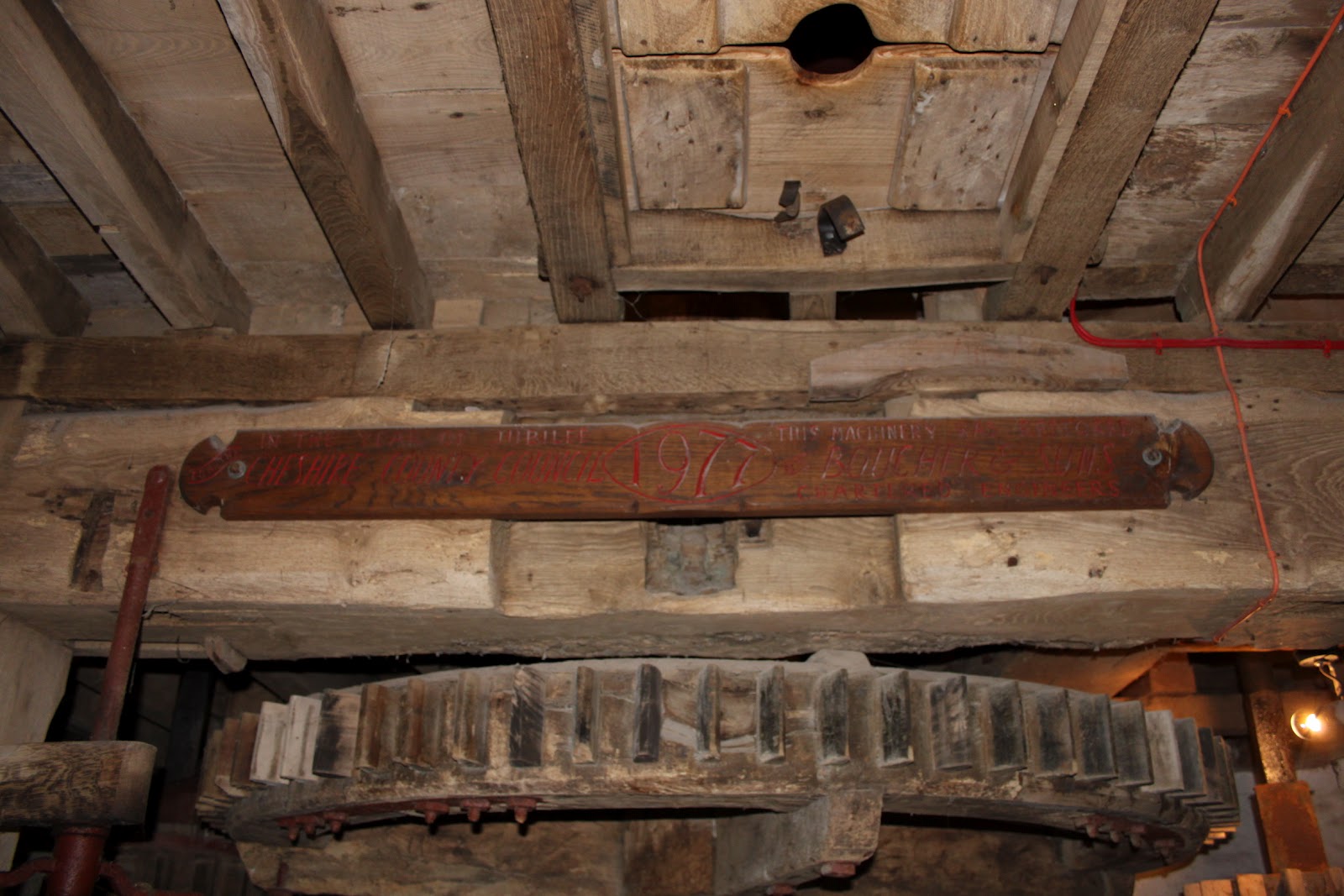
Downstairs in the mill, a board commemorates the restoration of the mill in the 1970s by Dr Cyril Boucher.
And the first grinding of wheat following the restoration is recorded as a simple pencil note on an oak beam.
This simple inscription on the sandstone of the chimney inside the mill records the initials PB several times, once alongside the date 1712.  We assume PB was as miller at Stretton but not found any further details about him yet.
And finally a couple of dates for your diary.  On Saturday 8th and Sunday 9th September, there will be free tours of Stretton Watermill to celebrate Heritage Open Days, and on Saturday 29th and Sunday 30th September 2012 the mill will once again be hosting a Victorian Harvest Weekend with corn grinding, apple pressing, butter making, tastes of harvest cakes along with games and period music.  Hope to see you there.

Thursday, 21 June 2012

Lights, Camera, Action!

We've just been doing a bit of filming at Stretton Watermill, where our mill was playing the part of the old Dee Mill at Chester.  It's to be included in a major exhibition at the Grosvenor Museum next year exploring medieval Chester.  As the famous Dee Mills have long since gone, Stretton was the perfect substitute location as a nearby mill dating back to the mid-fourteenth century.

The mill section of the film features the miller's wife discussing trade in Chester and the Mystery Plays' links with millers and bakers whilst operating the watermill in her husband's absence.

Other scenes will include a Welsh pilgrim at St John's church, a Cheshire archer at the Water Tower and the Abbot of St Werburgh's in the abbey, (today Chester Cathedral).  The scenes are all linked by a narrator who was also included in the scenes at the mill.

Look out for this appearing in 2013, but in the meantime you can learn more about the Mapping Medieval Chester project on this website.

Monday, 16 April 2012

The Wartime Mill

We've just had a lovely weekend at the mill exploring some of the more recent history of the building. 

Since around 1870, the mill had been grinding animal feed rather than flour for people.  But when the Second World War broke out in 1939, Britain's grain supplies from Canada were blockaded in the Atlantic and the steam mills at Liverpool were being blitzed.  Hundreds of little rural mills, including Stretton, which had been clinging on to existence were to rise to the challenge during those dark days and play their part in feeding the nation.  Stretton Watermill was operating night and day, seven days a week to produce the flour needed.

Volunteers in the Women's Land Army worked in fields in the area, converting pasture land into arable for a more productive food resource.  One lady who had been a Land Girl stationed at nearby Tilston told us how on her first day she was sent by the farmer to take a cart load of grain to Stretton Mill.  She had never been close to a horse before and was a little nervous.  She needn't have worried, as the horse knew the way and took the grain, waited for the flour and returned to the farm without her having to touch the reins. 

So we welcomed visitors, collecting some stories and memories along the way.

We laid on a display of ration book recipes, including mock sausages, eggless cake and the famous Woolton Pie.

In between blasts from the portable air raid siren we listened to wartime songs on the gramophone. 

Children tried "German Jumps" - skipping with elastic and seeing how far their could get the stirrup pumps squirting. 

A folding paratroopers bicycle was spotted leaning against the watermill.

Chris told a tale of the rediscovery of a soldier's story etched on a water bottle which intrigued visitors and left some with tears in their eyes.

We often think of our mill as being full of ancient stories, which indeed it is, but this was a lovely reminder of some of the memories which are just within touching distance today. 

Sunday, 18 March 2012

Plots and Plans

We've just enjoyed the mill pre-season meeting, when everyone gets together to plan the forthcoming events and work out what needs to be done for the re-opening to the public.  As usual, the creativity was fuelled by tea and biscuits.

Everything is about ready to go now.  Just a few finishing touches.  The mill re-opens to the public on Sunday 1st April 2012, and we already have several schools planning to visit soon after.  The first event of the season will be Wartime Mill on Saturday 14th and Sunday 15th April, from 1-5pm each day, look out for more details about this appearing here soon.  And our flagship living history event, the Tudor Festival will take place on Saturday 7th and Sunday 8th July 2012. 

The millers took the opportunity to work inside the overshot wheel for basic cleaning and maintainance before the mill pond is refilled for the new season's milling.  We can't wait now...

Sunday, 11 March 2012

More Bagpipes at the Mill

Yesterday was International Bagpipe Day, and as visitors or regular readers will know there is quite a link between millers and bagpipes and so we kick-started the events happening across Cheshire with an early morning blast at the mill playing a few tunes and processing around the site and a short way along Mill Lane, leaving a few passing drivers a little bewildered. 

Then it was off to deliver workshops in the Grosvenor Museum and Nantwich Museum and later rejoining some other millers, friends and more pipers at the Bagpipolorum! concert at St Peter's in Chester.  The whole day was great and we're very pleased that the local events started at Stretton.  Watch out for pipes returning to Stretton Watermill later in the spring.

Sunday, 26 February 2012

Horse Harnesses and...Bagpipes

On arriving at the watermill today there were several picnickers enjoying the view over the millpond, even in its very drained pre-season appearance and lots of walkers wandering past making the most of the sunny Sunday.  Our neighbours from the former mill cottage were out for a walk with their pony.

It's still about a month before the mill opens to the general public again, (1pm on Sunday 1st April as you've asked), but this early visit was to collect some items of horse tack that are normally stored in our stable block as they are going to be displayed in a forthcoming exhibition at the Grosvenor Museum in Chester entitled "Taking The Reins: Horses in Cheshire" which will run from 19 May to 23 September 2012.

But it was only a brief visit as it was then on to meet with musicians at the Carden Arms in nearby Tilston to make plans for International Bagpipe Day on Saturday 10th March.  This has been organised by the Bagpipe Society to raise the profile of this traditional instrument, which was once so popular in Cheshire.  There are several events taking place around the local area, but we're proud to say that it all kicks off at Stretton Watermill at the very beginning of the day at 8.30am with some medieval music at the mill to recall Chaucer's Miller from the Canterbury Tales of who he wrote "a baggepipe wel coude he blow and sowne, and therewithal he broghte us out of towne" 

There are many more links between mills and bagpipes, but they are other stories for another day.

Friday, 17 February 2012

Waking up after Winter

We're not quite back in action yet at Stretton Watermill, as the site rests in the winter months, but there are signs that things are stirring.  Schools are starting to prepare their trips to visit us this year and we've been busy planning these in.  The school visits are one of the great privileges of being involved with Stretton Mill, as the experience of seeing gears grinding, chains clanking and flour falling makes a lasting impact on young minds.  We regularly get parents bringing their children because they came when they were children themselves, so hopefully we will continue to intrigue and inspire this year.

These pictures were sent to us from Overleigh Primary School after their visit to see the mill working and to experiment with our gears and wheels to tie in with their 'Forces and Motion' workshop.

And another great thing about school trips to the mill is that the visit and workshops are free!  You can find out more via the official mill website.

Sunday, 15 January 2012

Apple Tree Wassail

Yesterday was Old New Year and millers gathered to wassail the apple trees at Stretton.  The trees give us a wonderful harvest of fruit in autumn and their wood can be used to fashion replacement teeth for the gears in the mill.  We've recently lost a few of our older trees and replaced them with young trees, all of which are old Cheshire varieties bringing intriguing stories with them.  We felt it was right to look after the old trees and the help the younger ones to flourish.  And so what better to do than keep the ancient tradition of wassailing the trees to help them bear well in the coming year.

As dusk fell, friends began to gather and share news, all feeling that we were taking part in something "old", a tradition to be kept alive.

We enjoyed mulled cider, keeping us warm against the crisp frost that had been around all day.

Tom told the story of the Apple Tree Man, a folk tale all about the wassail and how trees will look after us if we look after them.
Then we collected toast to hang in the branches for the birds and rattles and bells to drive off the witches before setting off to process through our trees.
We made our way back to the oldest apple tree at the mill, being led through the deepening dark by Tom playing the Apple Tree Wassail on his double pipes.

We sang to the old apple tree and poured cider on the roots.
And then it was off down the road to the friendly Carden Arms for food, catching up with friends and music.


We're looking forward to what the year brings for our apple trees and we'll be wassailing the trees again next year as our mill is all about keeping traditions alive.